
Wednesday is both the hardest and the easiest day of the week.
The hardest: the working week – or, rather, Brandin’s working week, the week, for me, of being at home with the children, trying to eke out minutes here and there to write or to record (or both) while they nap or are adequately distracted by the TV, or each other – is more than halfway done, but there are still two long days to go.
Those two days feel interminable. I try not to watch the clock, but I do anyway; every time my phone buzzes, or my head turns towards the oven, or the microwave (the only two clocks in the house, as we have yet to hang the enormous nautical clock Brandin’s mum gave us), I’m reminded just how long I have to wait until someone else is there to hold the baby, or to fetch the snacks, or to clean up whatever new mess has been made by the children, or the dog or, less frequently (but always more disgustingly) the cat.
The easiest: it’s the first day of the week we have only two children in the evening. Two mouths to feed, one of whom eats only three meals (pasta, pizza, McDonald’s chicken nuggets), the other having not quite got it together enough to complain or to argue. Sure, he can shout, but he saves that for special occasions.
In some respects, these two are the easier of the four children. In others, of course, it’s a relief when they can wipe their own bums, brush their own teeth, grab their own snacks.
On this particular Wednesday, Brandin’s late home. He stops at the pharmacy to pick up his prescription. He runs into the supermarket to get some things we need. These are necessary stops, and yet I’m annoyed by them because it means I’m at home, with the children, wiping noses and bums and picking goldfish up off the floor for longer than I’d bargained for.
I’ve decided I want to go to the framers when he gets home. A family friend offered to buy us a present for our new house, and we asked if she’d buy us a gift card for the framers. We always have a pile of paintings and prints and photographs to frame.
Right now, the pile is the biggest it’s ever been. Framing is an expense that never feels necessary; paying to have your art custom-framed is a rich person’s game, and we haven’t felt like rich people in a while.
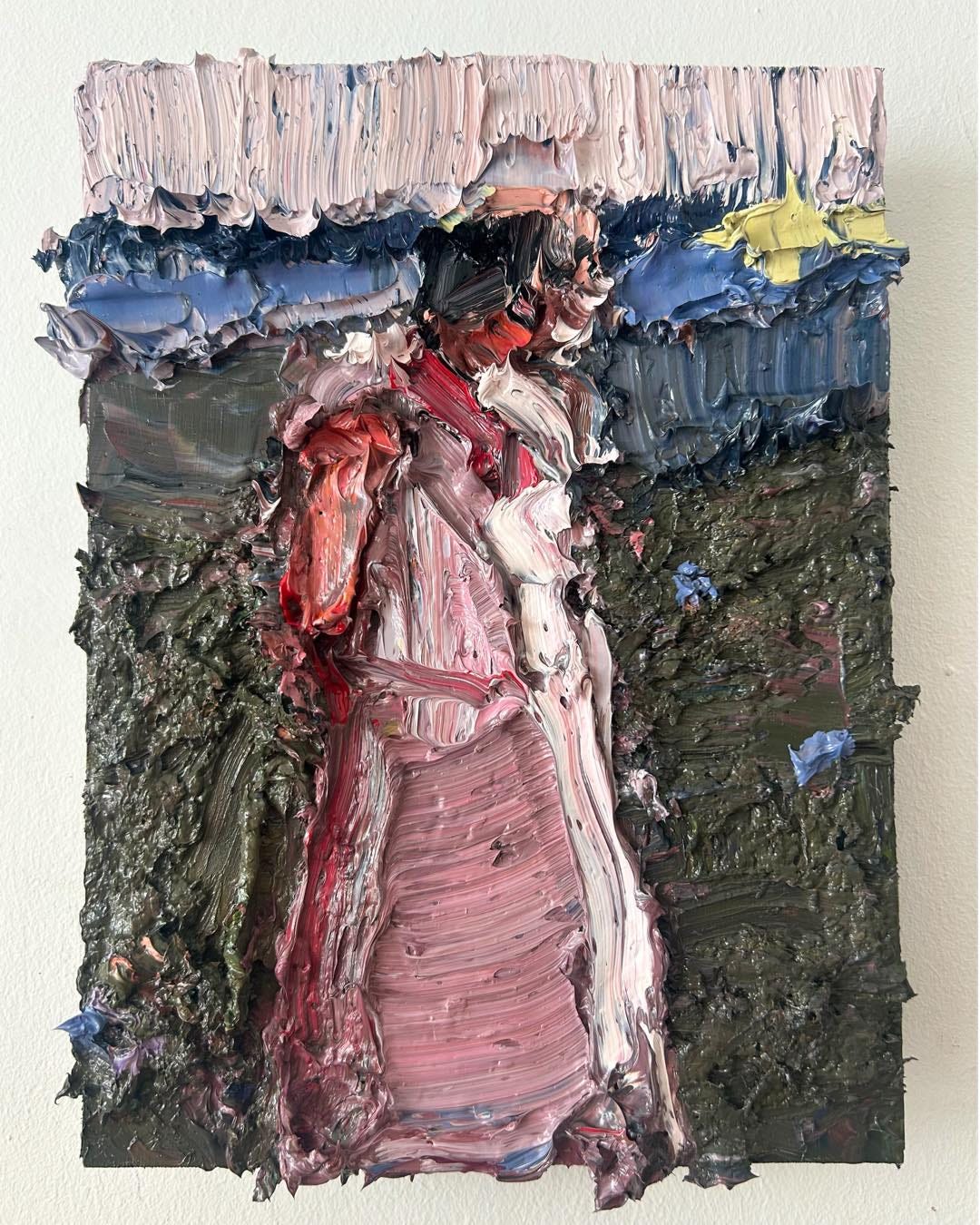
I’m going to bring my latest acquisition: an oil painting by Marolize Southwood, a South African artist whose work I stumbled across on Instagram. I’d bought it as a gift for my own birthday, earlier this year, before we sat down to look at our debt and began our budget. It’s the last thing I treated myself to, in the before times.
When it arrived, it sparked great debate. I see a very specific scene; my sister sees a very specific body part; my children are unsure. One sees the sea. Another, a mountain. It’s called Pulling Teeth, which doesn’t really do much to illuminate things.
In any case, it doesn’t matter to me what the artist meant it to be, or what anyone interprets it as, not really. I love the colours. I love the texture. I love the movement of the paint, the way it hangs off the bottom edge.
Brandin gets home at 5, which is cutting it close, as the framers closes at 6. Still, it’s only 15 minutes from the house, so I start gathering my things: my glasses, keys, wallet. The painting itself. At the last minute, I decide to bring a set of three prints a friend gave us as a gift when Atlas was born: gummy bears by Irish artist Monika Crowley.
I’ve been meaning, ever since, to have them framed beautifully, to hang them in his room. But, like I said, we haven’t felt that rich in a while. I’m not against using shop-bought frames – our art is a combination of custom frames and Ikea – but these are a non-standard size, and the edges are rough, a feature I’d hate to obscure. I’d like them to float on an off-white mat, inside a pale frame. Maybe, I think, we’ll have enough to do them all – the bears and the Marolize Southwood. (I’m nothing if not optimistic.)
As I gather my bits, I tell Brandin I’m heading out to the framers. It seems important, somehow, to do this: to get out of the house, to speak to someone else, out in the world, to get in the car and drive, even if it’s only 10 minutes around the corner.
We’re on a budget now, so I won’t be stopping for a coffee or a large Diet Coke (much as I’d like to). Nor will I be wandering into Goodwill for a browse, or taking a stroll around Walmart. I’ll go to the framers and back, just that, but that will be something.
Brandin tells me that he’s parked in the driveway, he’ll have to move his truck. He hands me the baby, takes his keys off the rack, puts on his shoes back on.
I am disproportionately annoyed by this. Not the fact that I have to wait, while holding the baby, necessarily, although I do have a split second where I think, imagine if he just got in his car and drove off, as I would, honestly, quite like to do, quite often. Imagine. I don’t have to imagine, I realise. He does that every day.
No: I’m irritated by his parking in a way that prevents me from leaving, as if he’d just assumed I wouldn’t want to. Of course Rosemary’s at home; of course Rosemary will stay at home; Rosemary never goes anywhere; Rosemary never leaves the house.
I do sometimes leave the house, you know! I want to tell him, indignantly, but I suppose the truth of it is that mostly I don’t. I walk to the corner with Atlas and he gets on the bus and then I come back and I hang out with Roman and then, when Atlas is home, they both go down for their naps and I sit at the table, or on the couch, or on the bed, and keep vigil.
There are places I could go: we’ve gone to the YMCA, where, at last count, Roman lasts nine minutes in childcare before they call me to come pick him up. “He hasn’t really calmed down since you left,” they tell me, and I feel terrible, even worse when I push through the doors and see his face, tears and snot everywhere.
I feel less bad, mind you – and more murderous – when they hand him over to me and he immediately starts to clap his hands, a broad smile on his face. He’s grand! I feel like telling them. I contemplate handing him back. Instead, we go home. “We’ll try again tomorrow,” I tell him, but we don’t, because I can’t face packing up all of our things in the car for a nine-minute stay at the Y. Maybe the day after tomorrow.
Sometimes we go to the library, but the downtown branch, which opens at 9am, is a 30-minute drive from the house, so we’d have to leave by 10.30am, to be home in time to get Atlas off the bus. The branch nearer us, a five-minute drive, give or take, doesn’t open until 10am, so a trip there feels even more pointless.
It doesn’t help that, right now, I’m trying to go to free places. I’m trying not to go to the nice cafes with the play places, where I inevitably spend $20-odd on coffees and cake pops and whatever else I (and my children) fancy. It doesn’t help that, right now, the list of places I could go feels shorter than usual.
Once Brandin has moved his car – stopped, quite literally, holding me hostage in the house – I head off without so much as a backwards glance.
My mother thinks you should always say goodbye to a child, so that they don’t get a surprise (a bad one) when they realise you’re not there. I think I do a good job of pretending to ignore her advice, most of the time, but it all gets absorbed anyway. In the end, it feels less like advice and more like a directive.
Still, today I don’t say goodbye to the children. I’ll be back within the hour, sure, and I can’t face the protracted goodbye, the “where are you going, mommy?!”s, the “can I come with you?!” even though, of course, he can, or could, if I waited long enough for him to ask.
Today I don’t. I head out and I drive to the framers listening to The Idiot, a podcast by the creators of Serial, about a man whose cousin – a cousin he’d never really liked – is arrested and jailed as part of an FBI sting operation. It’s got everything: Russian accents (a post-Heated Rivalry fixation of mine), a crazy ex mother-in-law, child abduction (?!), murder for hire…
The framers is empty when I walk through the doors. I guess no one’s feeling rich these days, I think, but then she tells me they’re so busy their framing times are three weeks at a minimum. “Do you need this in a hurry?” she asks.
What kind of life would I be living if I did need this framed in a hurry? I suppose I could be framing it as a gift for someone else, but I feel as though frames are a very personal choice. The vast majority of options I see lining the walls are, quite frankly, hideous. I dread to think what someone would choose to frame my Marolize Southwood in, or my gummy bears.
We start to talk through our options, and I tell her my budget. She is, to her great credit, nonplussed, but she casually halves the pile of frames she’d been gathering for me to choose from. The Marolize Southwood, she tells me, will cost $211 to frame, and that’s with, truly, some of the cheapest options available.
“A lot of these frames come from Italy, so that really bumps the prices up…” she says, apologetically. I wonder if the tariffs have had a big impact there, but I don’t ask her, because the word “tariff” feels politically charged, somehow, and honestly? I’d rather not know if she’s someone whose business I shouldn’t be supporting.
I ask about the gummy bears, suddenly feeling like I should frame those first. They’re for Atlas, after all, while the other painting is for me and, as a result, feels like it should be lower down the priority list (why do we do this? Do men do this?!).
We talk through a few different options for the gummy bears and, again, having whittled our choices down to the most affordable, she goes over to her computer and does the calculations. “For these it’ll be…” she says (tap, tap, tap)… “One hundred and seventy-five dollars each.”
I decide to frame my own painting. Maybe, I think (naively, as it happens), we’ll get some money back on our taxes, and I can put that towards the gummy bears. Maybe they can be next.

While I’m waiting to pay my extra $11, a notification pops up on my phone. “Attending your appointment virtually? Log on at…” I have a moment of confusion, before I remember I have a psychiatry appointment at… now. Right now, in fact.
I’d entirely forgotten about it, despite its being in my calendar. This forgetfulness – forgetting appointments, weekend plans, entire conversations – is, apparently, a symptom of my recently diagnosed ADHD, but as I’m still skeptical about that whole diagnosis (do I really have inattentive ADHD? Am I not just lazy and bad at being an adult?!), I find this hard to accept and, instead, feel a lot of guilt and shame about it. It’s embarrassing, to be constantly forgetting things. It makes me feel old and all over the place.
I rush through the payment – “I’m sorry, I just realised I’m supposed to be on a call with my psychiatrist!” I tell her, which is maybe an overshare, as I run out to the car – and log on to my appointment on my phone. I open the car door, sit in the driver’s seat, attach the phone to the magsafe holder on the dashboard.
“Hello there,” my psychiatrist says as he comes into view, sitting in the office I was meant to be sitting in. (I try to attend our appointments in person since I learned he prefers it, because I’m nothing if not a people pleaser, but, you know, see above re forgetfulness.) “Where are you today?”
I think he’s asking this for legal reasons, so I tell him I’m in my car, near my house, “still in Indiana.” Many medical providers are only licensed in the state they practise in, so if you’re out of state on holidays, you’ve to either lie, and pretend you’re not, or reschedule. I, of course, would never lie.
“But where,” he asks, “where are you, what are you doing?”
I remember, now, how delighted he was the day I logged on for our appointment from the farm; how many questions he asked me about the blackberry bush I was standing under. He’s a curious man.
“Oh,” I say. “I’m at the framers. I’m just having some art framed.”
“Ah!” he says (delighted, again). “I didn’t know you were an art aficionado!”
I’m embarrassed by this and I’m not sure why. It’s the kind of thing that could be said in a mocking tone, but I’m 99% sure he’s being sincere. (We’re in America, so people are almost always being sincere, which is exhausting.)
“Oh, uh, I wouldn’t say aficionado,” I say, “I just… have a lot of art, and a lot of it is unframed, so…”
“What are you having framed?!” he asks. “Is it a painting? A photograph?”
“A painting,” I say. “An oil painting I bought for my birthday.”
If he’s surprised at the idea that I would buy my own birthday gift, he doesn’t show it.
“Is it by a local artist? Who did this painting?” He’s nothing if not persistent.
“It’s by a South African artist named Marolize Southwood,” I tell him. He nods (go on). “I actually can’t remember where I first saw her work… it’s just a beautiful piece. No one can decide what they see, but I loved the colour and the brushwork…” I trail off.
“How wonderful!” he says. Again, seeming very sincere. “Now!” he says, as if we have got through something, and are ready to begin. “How have you been doing?”
I tell him. I feel like the ADHD medication has helped. I’m more focused, more productive. For the first time in my entire life, I feel like an adult. (I’m now embarrassed about all of the times I’ve made jokes about how hard adulting is, like I’m Tom Hanks in Big, accidentally in the body of a grown woman when I am but a girl, yearning to jump around on a giant piano.)
But it’s not all good, I tell him. I’ve been struggling, these past few weeks, with feeling very anxious and low at times. But I think – who’s the psychiatrist here, I wonder, as I type this – this has something to do with the GLP-1. I’m no longer comfort eating, I tell him, but I’m no longer comfort shopping, either. And, as these two things (eating, shopping) are the tools I used to give myself joy, in the before times, I wonder if I just need to find something else that makes me happy. Or something.
I realise I’m rambling, so I stop talking. I remember, when I studied journalism, being told to embrace silence, especially when interviewing. For someone who lives to fill an awkward silence, this has never been easy. But in interviews, as in psychiatry appointments, it feels important to hear what the other person has to say, and to give them the space to say it.
“You know what? I want to say something,” he says, then (was he waiting for a silence?! I’m embarrassed by this, too – why do I never know when to shut up?!1). “I’m proud of you,” he tells me. “The way you said that – that you know you’ve been using food and shopping this way – a lot of people would feel shame saying that. But you were able to tell me, without shame. That’s a very good thing.”
It occurs to me, then, that my psychiatrist doesn’t really understand me at all. He’s proud of me for disclosing something about myself that other people would find shameful, without any shame?! I should put him on to my mother. Maybe he could encourage her to be proud, too.
“Are you seeing a therapist at the moment?” he asks, and I say no, I’m not. I had been, but when we moved house, when we didn’t get a new babysitter, when I started working all the hours God gave me, around naps and snacks and nappy changes, I realised I simply didn’t have the time (or, honestly, the money) for therapy. “Well, you should be in psychotherapy,” he says. Written down, it looks like he might have been admonishing me, but it felt like a neutral statement.
Or, it would, if, the first time we met, he hadn’t said to me, “I don’t think therapy will work for you – you’re too sensible.” DOES HE NO LONGER THINK I’M SENSIBLE?!?!
Not recognising my panic at this pronouncement – is he maybe… not a good psychiatrist?! – he then tells me, “You need to get out of this if… then thinking. You need to stop thinking, if this, then I will be happy. If that, then I will be happy. If I find a hobby, then I will be happy. This is a road to nowhere. This is a road to failure.”
Unfortunately, this makes a lot of sense. I’m always looking for The Thing that will make me happy, The Thing that will replace comfort eating and comfort shopping and comfort hanging out with the friends I’ve known since I was four and comfort sitting on my parents’ couch and comfort making inappropriate jokes and knowing no one will think I’m serious and comfort napping and comfort clearing out my wardrobe and comfort cutting my hair and all of the many possibly not great behaviours I employ when I feel like I need something to lift me out of the mire.
“Do you use AI?” he asks, then. There’s a pause.
“Well,” I tell him, carefully, because I don’t want him to think I’m lecturing him, and I also don’t know where he’s going with this. Is he about to suggest that I sound like someone who’s addicted to Chat GPT? Is he wondering whether I’ve got an AI boyfriend? (Who has the time?!) Is he about to suggest that I go to Chat GPT for suggestions on how to fix my brain?
“I’m a writer, you know,” I say. (Does he know?! I suspect he’s forgotten.) “So I’m kind of… [KIND OF?!?!] fundamentally against AI.”
“Ah,” he says. “Well, let’s not throw the baby out with the bathwater.” (It’s ironic that he mentions water in this discussion about planet-destroying AI, but go off.) “I think that you could take the advice that I’ve given you, and go to Chat GPT, and say, ‘this is what my psychiatrist suggests. These are the challenges I face. Can you recommend some books I could read on these topics?’”
This seems like sound advice, although I do wish there was another way to go about this. Couldn’t he just recommend some good books to me?!
My Irish therapist used to recommend books to me all the time, although, now that I think about it, I never read them, and then would feel a sense of abject failure and worry I was about to disappoint her and cancel our next two appointments (and pay full whack), and then hope that, three weeks later, she’d have forgotten all about the homework she’d given me, which I hadn’t done.
“Hmmm,” I say. (Hmmm!) “Okay, I can see how that would work.”
I tell him I’ll do that. (Reader, I have yet to do it.) He tells me he wants to keep my medication where it’s at, which is fine by me; I feel like I’m still figuring out how my body feels on an anti-depressant plus an anti-anxiety medication plus a stimulant plus a GLP-1 plus a multivitamin (when I remember).
My body’s processing a lot of chemicals in there – and we haven’t even touched on perimenopause.
I’ve been reading a lot about ADHD, lately. I borrowed a book from the library about it, and I’ve started following some ADHD-themed Instagram accounts. And a lot of the things that I feel ashamed about in my personality are, you guessed it, ADHD-related. So maybe I should get over my theory that I might not have ADHD and am just lazy. Maybe I should accept that I do have ADHD. Because letting myself believe that these things aren’t my fault sounds like it would be quite nice. Life-changing, even.
The painting is beautiful 🤩